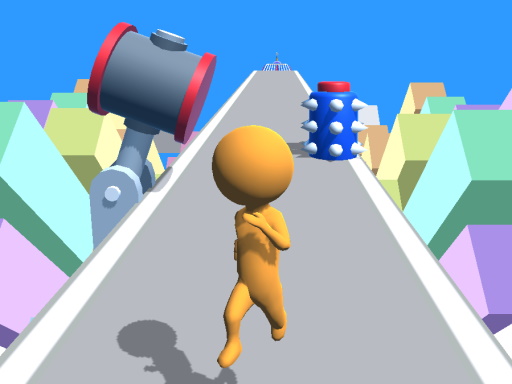
Stickman Gradient is an amazing stickman running game. Your mission in this game; Avoiding obstacles while running through the city streets. You have to be careful and watch out for obstacles while playing this running game.
The edge case worth knowing in Stickman Gradient: a run that looks lost is often recoverable if you slow down instead of quitting. I have saved more runs by pausing for a breath than by rushing to fix a mistake.
My messy first run of Stickman Gradient
I only meant to try Stickman Gradient for a few minutes. It was one of those in-between moments — a short break, a tab already open — and I clicked the card almost without thinking. The first run lasted about 9 minutes and ended with a modest score of around 860, which is exactly why I stayed. Nothing about it felt like homework. It felt like a game that wanted one more try, and then one more after that.
What kept me there was not a single big moment. It was the small loop: start, learn a little, do slightly better, repeat. I have played plenty of Hypercasual games that explain too much before they let you play. Stickman Gradient does the opposite. It lets you touch the game first and figure the rest out while you are already moving, and that first, slightly messy run is part of the fun rather than a failure.
Why Stickman Gradient is worth your break time
I kept coming back to Stickman Gradient because the benefits showed up in my own routine, not in a list. First benefit: it does not ask for your time. One run fits into a short break, and you can go back to work without feeling like you left a game half-finished. Second benefit: learning happens gradually. A brand-new player can enjoy it from day one, because the game teaches you as you play instead of punishing you for not knowing it yet.
The third benefit is the one I felt personally: focus. When I play Stickman Gradient, my attention is only on the screen — no phone, no second tab. Five minutes of that kind of focus often carries into the rest of my day. And the last benefit is replay value. Every run feels different, so boredom takes a long time to arrive. If you like Hypercasual games, Stickman Gradient is a solid, lightweight option, with no download and nothing to pay.
If you enjoy Stickman Gradient, also try Trio Twist Puzzle, Steal Simulator, Spiny Ninja — same category, a different challenge.
One more thing. Don't compare your first score with anyone else's. Compare it with your second score. That is the only comparison that tells you anything useful.
Common issues in Stickman Gradient and what to do
Now the honest part: Stickman Gradient can have issues too, like every browser game. I have seen these myself or watched other players hit them, and the fixes below are the ones I actually used. These are general browser-game problems, not a claim that this specific game is broken.
| Issue | Why it happens | Solution |
|---|---|---|
| Game does not load | Slow internet or a stale browser cache | Refresh the page, close other tabs, and check your connection. If it still does not load, try a different browser. |
| Controls do not respond | The player never got focus | Click inside the player first, then use the keys or mouse. Try the fullscreen button too. |
| Game lags or runs slowly | Too many open tabs or an old browser | Close extra tabs, update your browser, and reload the game. |
| No sound | Browser blocked autoplay or sound is muted | Click inside the player, check the browser sound icon, and look for the in-game sound setting. |
If none of those fixes work, close the game once and open it again. That single step is often enough, and your next run starts fresh.
How to play Stickman Gradient — the mini-manual
This is the mini-manual for Stickman Gradient — what to click, what happens, and what you get. No guessing, no manual to download.
| Step | What to do | What you get |
|---|---|---|
| 1 | Click Play on the game page | The game loads in the player, ready to start |
| 2 | Click inside the player | Your mouse and keys control the game |
| 3 | Play one learning run | You learn the layout and the rules, with no pressure |
| 4 | Use fullscreen for a focused run | A bigger view, fewer distractions, better control |
| 5 | Replay and beat your own best | A fresh run and a clear target to chase |
If anything feels off, pause and check the in-game prompts first. They are the final word on controls for Stickman Gradient.
Levels, combos and progress in Stickman Gradient
Scoring in Stickman Gradient is best understood as progress plus consistency. A single good move helps, but a run of good moves without a careless mistake helps far more. Think of it in words rather than a formula: your score grows with what you do well, and it grows faster when you chain good moves together instead of breaking the chain.
| Milestone | Illustrative example score | What it usually means |
|---|---|---|
| First solid run | 780 | You understood the basics and finished a clean run. |
| A good run | 2,692 | You kept your momentum and avoided early mistakes. |
| A strong run | 9,158 | You chained good moves and stayed focused to the end. |
Those numbers are examples to give you a sense of scale, not targets the game promises. Your own milestones will depend on how you play, and beating your own best score is a better goal than chasing someone else's number.
The small errors that cost runs in Stickman Gradient
Most problems in Stickman Gradient are not about talent. They are about habits, and habits can be changed in a single session. Here are the three I see most often.
- Playing with distractions. A phone buzz or a second tab costs more runs in Stickman Gradient than most players admit. One focused run beats three distracted ones.
- Ignoring the in-game prompts. The game usually tells you what it wants. Skipping those prompts and guessing instead wastes more runs than reading them once.
- Copying someone else's style blindly. What works for a fast player may not work for you in Stickman Gradient. Learn the pattern first, then make the style your own.
If you recognise yourself in one of these, fix only that one thing next time. Changing everything at once rarely works; changing one habit usually does.
How to control Stickman Gradient on desktop and mobile
BuilderGame does not store a per-game control scheme for Stickman Gradient, so treat the prompts shown inside the game itself as the final word. The table below covers the controls most browser games in the Hypercasual category use, and it is a reliable starting point if the game does not spell them out on screen.
| Control | What it usually does | When to use it |
|---|---|---|
| Mouse or tap | Select, aim or interact with on-screen elements. | Most menu and in-game actions. |
| Arrow keys or WASD | Move or steer. | Whenever the game needs movement. |
| Space or click | Jump, shoot or confirm an action, depending on the game. | Check the in-game prompt first. |
| Fullscreen button | Expands the player to fill the screen. | Use it for faster, more precise play. |
If a control feels wrong, pause and look for the instructions inside the game before changing your approach. Guessing for five minutes usually costs more runs than reading for thirty seconds.
How to play Stickman Gradient, step by step
This is the exact routine I used when I first played Stickman Gradient. Every step is small on purpose, so you never get stuck halfway through.
- Step 1 - Click inside the player. Click inside the player above so Stickman Gradient gets focus and your keys and mouse actually control the game.
- Step 2 - Play your first run just to watch. Forget the score. Just watch what changes on screen and what ends a run.
- Step 3 - Lock in the controls. Use only the mouse or tap, or the arrow keys or WASD — whichever this game actually uses — for one full run.
- Step 4 - Fix one mistake. Whatever went wrong most in your first run, focus only on that in the next run.
- Step 5 - Build your score in short runs. Play two or three short, fresh runs and try to beat your previous best.
These steps work because Stickman Gradient is a game you learn by playing, not by memorising. The player who learns in run one is the player who plays better in run two.
Further reading: Video game (Wikipedia) · Arcade game (Wikipedia) · Casual game (Wikipedia). These are general reference pages about the genre, not the game developer. This site never invents a developer link.
Frequently asked questions about Stickman Gradient
Is Stickman Gradient good for beginners?
Yes, it is a friendly starting point in the Hypercasual category. The first runs teach you the game as you play, and a messy first run is normal. Play a few short runs before judging it.
Is Stickman Gradient free to play?
Yes. Stickman Gradient plays free in the browser on this site. You do not need to buy anything to start a run, and there is no download or install step before you play.
How do I improve my score in Stickman Gradient?
Focus on consistency first. Slow down at the tricky parts, learn the pattern behind a good run, and replay short sessions instead of one long tired session. Your score usually follows once the pattern clicks.
How long does a run of Stickman Gradient take?
Most runs are short — a few minutes rather than an hour. That is part of the appeal: you can play one quick run in a break and come back later without losing your place, because each run starts fresh.
Can I play Stickman Gradient with friends?
Playing is usually a solo run, but you can share the game page with friends using the Invite friends button on the game page, so they can try the same game and compare scores.
Do I need an account to play Stickman Gradient?
No, not for playing. You can open Stickman Gradient and start right away. An account is only needed for extras like liking a game or posting a comment, not for the game itself.
What kind of game is Stickman Gradient?
Stickman Gradient is a Hypercasual browser game. That means it plays directly in your browser, in short repeatable rounds, with no download. If you enjoy that category, it is an easy game to pick up.