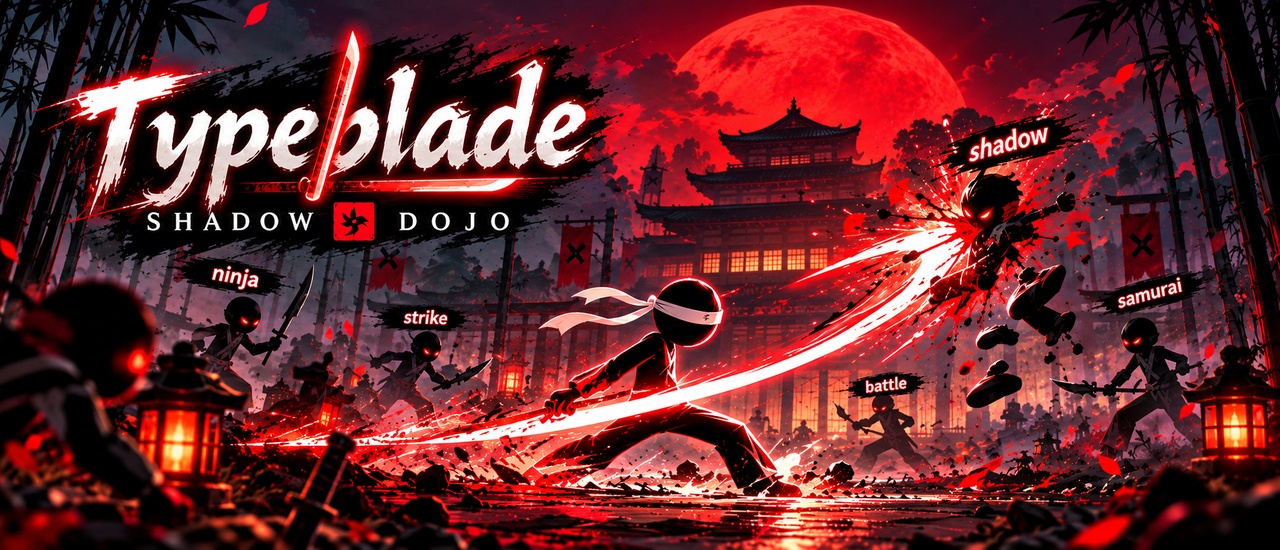
Defend the Shadow Dojo in a fast-paced typing action game! Use your keyboard as a weapon: type the first letter above an enemy to lock on, then complete the word to unleash a deadly sword strike. Build combos, increase your score multiplier, earn lifelines, and survive waves of Shadow Warriors, Night Runners, armored Oni Guards, and powerful Oni Lords. Fight through 20 waves and 2 boss battles in Dojo Trial, or test your skills in Endless mode. Collect coins to unlock blades and skins.
What surprised me most about Typeblade: Shadow Dojo: the game feels easy for the first minute and then quietly tests whether you were actually paying attention. That switch is where most players lose their first good run.
The evening I first tried Typeblade: Shadow Dojo
A sidebar suggestion is how I found Typeblade: Shadow Dojo, and I am glad I did not skip past it. I had been scrolling through Battle games looking for something quick, something that would not ask me to install anything or learn a manual first. The first run took roughly 9 minutes. I did not win anything worth bragging about — my score sat near 945 — but I understood the game by the end of that run, and that is rarer than it sounds.
Since then I have come back to Typeblade: Shadow Dojo in short bursts rather than long sessions. That suits it. A quick run fits between other things, and because each run resets cleanly, a bad run never ruins the next one. If you are the kind of player who likes to learn by doing, this is a good place to start.
What Typeblade: Shadow Dojo actually gives you
I kept coming back to Typeblade: Shadow Dojo because the benefits showed up in my own routine, not in a list. First benefit: it does not ask for your time. One run fits into a short break, and you can go back to work without feeling like you left a game half-finished. Second benefit: learning happens gradually. A brand-new player can enjoy it from day one, because the game teaches you as you play instead of punishing you for not knowing it yet.
The third benefit is the one I felt personally: focus. When I play Typeblade: Shadow Dojo, my attention is only on the screen — no phone, no second tab. Five minutes of that kind of focus often carries into the rest of my day. And the last benefit is replay value. Every run feels different, so boredom takes a long time to arrive. If you like Battle games, Typeblade: Shadow Dojo is a solid, lightweight option, with no download and nothing to pay.
If you enjoy Typeblade: Shadow Dojo, also try Plane Racing Stunts, Sniper Shot: Bullet Time, Super Wrestlers Slaps Fury — same category, a different challenge.
Real talk: I have written guides that sound perfect and help no one. This one is meant to be the opposite — a bit messy, a bit personal, and actually useful after your first run.
Common issues in Typeblade: Shadow Dojo and what to do
Now the honest part: Typeblade: Shadow Dojo can have issues too, like every browser game. I have seen these myself or watched other players hit them, and the fixes below are the ones I actually used. These are general browser-game problems, not a claim that this specific game is broken.
| Issue | Why it happens | Solution |
|---|---|---|
| Game does not load | Slow internet or a stale browser cache | Refresh the page, close other tabs, and check your connection. If it still does not load, try a different browser. |
| Controls do not respond | The player never got focus | Click inside the player first, then use the keys or mouse. Try the fullscreen button too. |
| Game lags or runs slowly | Too many open tabs or an old browser | Close extra tabs, update your browser, and reload the game. |
| No sound | Browser blocked autoplay or sound is muted | Click inside the player, check the browser sound icon, and look for the in-game sound setting. |
If none of those fixes work, close the game once and open it again. That single step is often enough, and your next run starts fresh.
Playing Typeblade: Shadow Dojo smarter, not longer
None of these tips require special skill. They are small, practical habits that make Typeblade: Shadow Dojo more enjoyable and, over a few runs, usually raise your score as a side effect.
- Play in short bursts. Two or three focused runs beat a long, distracted session, especially when you are still learning.
- Watch for sound and visual cues. Many browser games signal what is coming next. Listening and watching for those cues is often worth more than faster fingers.
- Replay, don't restart angry. After a bad run in Typeblade: Shadow Dojo, take one breath and play again. The next run is a fresh chance, not a punishment.
- Stop when you stop enjoying it. A game should stay fun. If Typeblade: Shadow Dojo starts feeling like a chore, a short break usually brings the fun back.
Try one tip per session. By the end of a week of short sessions, most players find that two or three of these have quietly become their normal way of playing.
Getting a better score in Typeblade: Shadow Dojo
Scoring in Typeblade: Shadow Dojo is best understood as progress plus consistency. A single good move helps, but a run of good moves without a careless mistake helps far more. Think of it in words rather than a formula: your score grows with what you do well, and it grows faster when you chain good moves together instead of breaking the chain.
| Milestone | Illustrative example score | What it usually means |
|---|---|---|
| First solid run | 739 | You understood the basics and finished a clean run. |
| A good run | 3,059 | You kept your momentum and avoided early mistakes. |
| A strong run | 6,090 | You chained good moves and stayed focused to the end. |
Those numbers are examples to give you a sense of scale, not targets the game promises. Your own milestones will depend on how you play, and beating your own best score is a better goal than chasing someone else's number.
What your Typeblade: Shadow Dojo score is made of
Scoring in Typeblade: Shadow Dojo is easier to understand as a formula than as a feeling. Think of it like this: your final score is your base points, multiplied by your combo, plus any bonus you picked up along the way. In plain words: play well, keep the combo alive, and the bonus adds on top.
| Part | What it means | Example value |
|---|---|---|
| Base points | Points from the moves you made in the run | 185 |
| Combo multiplier | How many good moves you chained without breaking | x4 |
| Bonus | Extra points from bonuses or a clean finish | 119 |
| Final score | Base x Combo + Bonus | 859 |
Worked example: 185 base points, times a combo of 4, is 740. Add the 119 bonus, and you get 859. That is why protecting your combo matters more than rushing for extra points — a broken combo costs you the multiplier, not just a few points.
Using Typeblade: Shadow Dojo: a short manual
This is the mini-manual for Typeblade: Shadow Dojo — what to click, what happens, and what you get. No guessing, no manual to download.
| Step | What to do | What you get |
|---|---|---|
| 1 | Click Play on the game page | The game loads in the player, ready to start |
| 2 | Click inside the player | Your mouse and keys control the game |
| 3 | Play one learning run | You learn the layout and the rules, with no pressure |
| 4 | Use fullscreen for a focused run | A bigger view, fewer distractions, better control |
| 5 | Replay and beat your own best | A fresh run and a clear target to chase |
If anything feels off, pause and check the in-game prompts first. They are the final word on controls for Typeblade: Shadow Dojo.
From first click to first win in Typeblade: Shadow Dojo
This is the exact routine I used when I first played Typeblade: Shadow Dojo. Every step is small on purpose, so you never get stuck halfway through.
- Step 1 - Click inside the player. Click inside the player above so Typeblade: Shadow Dojo gets focus and your keys and mouse actually control the game.
- Step 2 - Play your first run just to watch. Forget the score. Just watch what changes on screen and what ends a run.
- Step 3 - Lock in the controls. Use only the mouse or tap, or the arrow keys or WASD — whichever this game actually uses — for one full run.
- Step 4 - Fix one mistake. Whatever went wrong most in your first run, focus only on that in the next run.
- Step 5 - Build your score in short runs. Play two or three short, fresh runs and try to beat your previous best.
These steps work because Typeblade: Shadow Dojo is a game you learn by playing, not by memorising. The player who learns in run one is the player who plays better in run two.
Further reading: Arcade game (Wikipedia) · Online game (Wikipedia) · Video game (Wikipedia). These are general reference pages about the genre, not the game developer. This site never invents a developer link.
Frequently asked questions about Typeblade: Shadow Dojo
Can I play Typeblade: Shadow Dojo on mobile?
Yes. The player is full-width on phones and keeps its 16:9 ratio, so Typeblade: Shadow Dojo works in a mobile browser without a separate app. For the most precise control, try it on a larger screen too.
Is Typeblade: Shadow Dojo free to play?
Yes. Typeblade: Shadow Dojo plays free in the browser on this site. You do not need to buy anything to start a run, and there is no download or install step before you play.
Is Typeblade: Shadow Dojo good for beginners?
Yes, it is a friendly starting point in the Battle category. The first runs teach you the game as you play, and a messy first run is normal. Play a few short runs before judging it.
Can I play Typeblade: Shadow Dojo with friends?
Playing is usually a solo run, but you can share the game page with friends using the Invite friends button on the game page, so they can try the same game and compare scores.
Why does Typeblade: Shadow Dojo feel different on another site?
The game itself is the same kind of browser game, but each site presents it with its own layout, related games and article. This page's guide, examples and related games are generated for this site and this game, which is why they differ from page to page.