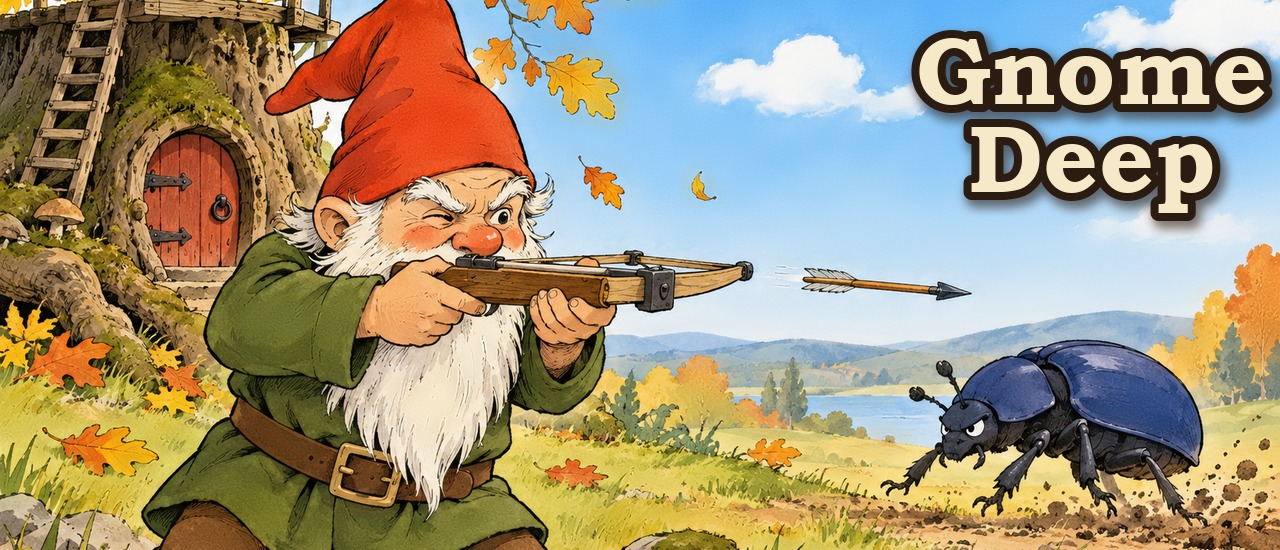
Gnomes are digging under an old oak stump for the lost Gnome King's hoard, and every pest can hear them. Dig louder for more gold and a faster dig, but the louder the digging, the more beetles, slugs, crows and worse come for the burrow. Crossbow gnomes, a catapult, an old owl and a cousin with a shovel hold the walls. Every new layer wakes a boss that blocks the tunnel. When the burrow falls, spend your gems in the workshop and dig deeper next time. Eight layers down, the Wyrm is waiting.
Honestly? The best run I had wasn't my highest score. It was the run where I finally stopped panicking. Slow hands. Eyes on the whole screen, not just the centre. That run felt different — calm, almost boring — and it scored better than every frantic run before it.
Strategy is just planning with a timer. Before you act, ask: what does this move cost me two moves from now? That one question, asked every time, changes everything.
The evening I first tried Gnome Deep
I was looking for a new Strategy game when Gnome Deep caught my eye, mainly because it looked easy to start and hard to put down. I gave it one run to prove me wrong. It took about 9 minutes, I scored around 1,171, and I immediately wanted to beat that number. That is the whole appeal in one sentence: a low barrier to start, and a clear reason to try again.
The best way to approach Gnome Deep is the way I did — play first, read later. Let the first run be messy. Notice what trips you up, then change one small thing on the next run. Players who do that tend to enjoy it far more than players who try to master everything before they start.
Good things about Gnome Deep, honestly
I kept coming back to Gnome Deep because the benefits showed up in my own routine, not in a list. First benefit: it does not ask for your time. One run fits into a short break, and you can go back to work without feeling like you left a game half-finished. Second benefit: learning happens gradually. A brand-new player can enjoy it from day one, because the game teaches you as you play instead of punishing you for not knowing it yet.
The third benefit is the one I felt personally: focus. When I play Gnome Deep, my attention is only on the screen — no phone, no second tab. Five minutes of that kind of focus often carries into the rest of my day. And the last benefit is replay value. Every run feels different, so boredom takes a long time to arrive. If you like Strategy games, Gnome Deep is a solid, lightweight option, with no download and nothing to pay.
If you enjoy Gnome Deep, also try Side Defense, Heroes Towers, Castel War 3D — same category, a different challenge.
Side note — if you are reading this guide before playing, stop here and play one run first. Seriously. Half of what follows will make more sense after you have lost one run yourself.
Common issues in Gnome Deep and what to do
Now the honest part: Gnome Deep can have issues too, like every browser game. I have seen these myself or watched other players hit them, and the fixes below are the ones I actually used. These are general browser-game problems, not a claim that this specific game is broken.
| Issue | Why it happens | Solution |
|---|---|---|
| Game does not load | Slow internet or a stale browser cache | Refresh the page, close other tabs, and check your connection. If it still does not load, try a different browser. |
| Controls do not respond | The player never got focus | Click inside the player first, then use the keys or mouse. Try the fullscreen button too. |
| Game lags or runs slowly | Too many open tabs or an old browser | Close extra tabs, update your browser, and reload the game. |
| No sound | Browser blocked autoplay or sound is muted | Click inside the player, check the browser sound icon, and look for the in-game sound setting. |
If none of those fixes work, close the game once and open it again. That single step is often enough, and your next run starts fresh.
How to enjoy Gnome Deep more, run by run
None of these tips require special skill. They are small, practical habits that make Gnome Deep more enjoyable and, over a few runs, usually raise your score as a side effect.
- Play the first minute twice as slow. The opening of Gnome Deep decides the whole run. Slow down there, and the rest gets easier.
- Stop when you stop enjoying it. A game should stay fun. If Gnome Deep starts feeling like a chore, a short break usually brings the fun back.
- Replay, don't restart angry. After a bad run in Gnome Deep, take one breath and play again. The next run is a fresh chance, not a punishment.
- End on a good run. Stop Gnome Deep after a run you are happy with, not after a frustrating one. You will come back more willingly tomorrow.
Try one tip per session. By the end of a week of short sessions, most players find that two or three of these have quietly become their normal way of playing.
What most players get wrong in Gnome Deep
Most problems in Gnome Deep are not about talent. They are about habits, and habits can be changed in a single session. Here are the three I see most often.
- Skipping a practice run. A throwaway first run teaches you the layout for free. Players who skip it often spend their first three real runs learning what one practice run would have shown them.
- Rushing the first minute. Many players try to go fast before they know what they are looking at. The first minute of Gnome Deep is better spent learning the screen than chasing points.
- Copying someone else's style blindly. What works for a fast player may not work for you in Gnome Deep. Learn the pattern first, then make the style your own.
If you recognise yourself in one of these, fix only that one thing next time. Changing everything at once rarely works; changing one habit usually does.
From first run to high score in Gnome Deep
Scoring in Gnome Deep is best understood as progress plus consistency. A single good move helps, but a run of good moves without a careless mistake helps far more. Think of it in words rather than a formula: your score grows with what you do well, and it grows faster when you chain good moves together instead of breaking the chain.
| Milestone | Illustrative example score | What it usually means |
|---|---|---|
| First solid run | 639 | You understood the basics and finished a clean run. |
| A good run | 2,823 | You kept your momentum and avoided early mistakes. |
| A strong run | 6,220 | You chained good moves and stayed focused to the end. |
Those numbers are examples to give you a sense of scale, not targets the game promises. Your own milestones will depend on how you play, and beating your own best score is a better goal than chasing someone else's number.
Your first game of Gnome Deep, step by step
This is the exact routine I used when I first played Gnome Deep. Every step is small on purpose, so you never get stuck halfway through.
- Step 1 - Click inside the player. Click inside the player above so Gnome Deep gets focus and your keys and mouse actually control the game.
- Step 2 - Play your first run just to watch. Forget the score. Just watch what changes on screen and what ends a run.
- Step 3 - Lock in the controls. Use only the mouse or tap, or the arrow keys or WASD — whichever this game actually uses — for one full run.
- Step 4 - Fix one mistake. Whatever went wrong most in your first run, focus only on that in the next run.
- Step 5 - Build your score in short runs. Play two or three short, fresh runs and try to beat your previous best.
These steps work because Gnome Deep is a game you learn by playing, not by memorising. The player who learns in run one is the player who plays better in run two.
Further reading: Online game (Wikipedia) · Casual game (Wikipedia) · Arcade game (Wikipedia). These are general reference pages about the genre, not the game developer. This site never invents a developer link.
Frequently asked questions about Gnome Deep
How long does a run of Gnome Deep take?
Most runs are short — a few minutes rather than an hour. That is part of the appeal: you can play one quick run in a break and come back later without losing your place, because each run starts fresh.
Is Gnome Deep good for beginners?
Yes, it is a friendly starting point in the Strategy category. The first runs teach you the game as you play, and a messy first run is normal. Play a few short runs before judging it.
Can I play Gnome Deep on mobile?
Yes. The player is full-width on phones and keeps its 16:9 ratio, so Gnome Deep works in a mobile browser without a separate app. For the most precise control, try it on a larger screen too.
Why does Gnome Deep feel different on another site?
The game itself is the same kind of browser game, but each site presents it with its own layout, related games and article. This page's guide, examples and related games are generated for this site and this game, which is why they differ from page to page.
How do I improve my score in Gnome Deep?
Focus on consistency first. Slow down at the tricky parts, learn the pattern behind a good run, and replay short sessions instead of one long tired session. Your score usually follows once the pattern clicks.
What kind of game is Gnome Deep?
Gnome Deep is a Strategy browser game. That means it plays directly in your browser, in short repeatable rounds, with no download. If you enjoy that category, it is an easy game to pick up.